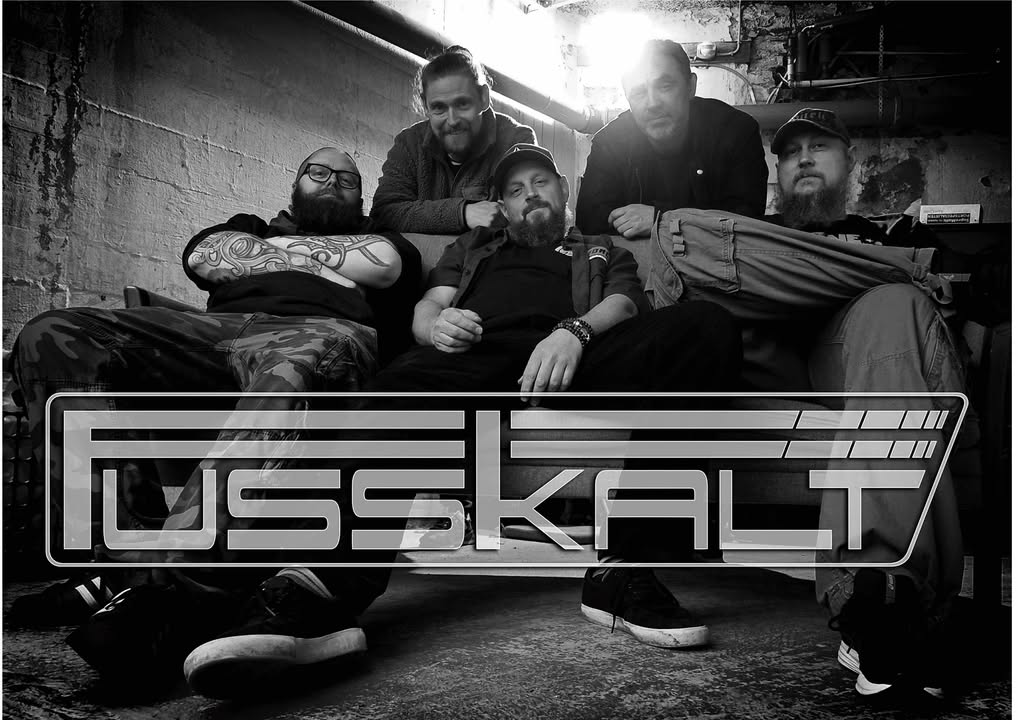
Fusskalt might not be a household name for every stoner rock fan — but it should be. Their new EP, Faceless Man, marks a clear step forward: musically more mature, yet still raw and honest.
This interview offers a closer look at who they are, where they come from, and how they stay true to themselves in an ever-shifting underground scene.
Their answers reveal more than just musicians — they’re teachers, graphic artists, gardeners. But above all, they do it with passion. They move slowly, but always forward.
Origins and evolution
How did Fusskalt get started? What inspired you to form the band?
-Many years ago, I (Nick – guitars) got together with and old drummer friend of mine, Mike – whom I played with way back in the day, when I first started getting into music and band relations. None of us had been playing in a band for some years at the time we got together again, and we thought it’d be fun. We just started writing and playing some tunes out of his apartment, and it was not really stoner rock or anything of the sorts. We both came from death metal and thrash etc. so it was more in that direction at that time. So the initial inspiration was just the absence of music (from a band perspective) in our lives – and the desire to play again.
Your name comes from Danish slang – is there a story or joke behind it?
-Technically correct, though it’s the German equivalent of the Danish word “fodkoldt”, which doesn’t really have a direct English translation, but we usually say that it’s a term describing when it’s not cold enough in your house, that you put on a sweatshirt, but still cold enough that you put on your slippers. I guess the English word would be footcold?
Anyways – it was actually just a fun working title, but it quickly grew on us and not long after, I created the original logo – and then it was kinda final. Rolls nicely of the tongue though, right?
Your sound has evolved a lot since the early EPs. Was this a conscious shift or a natural progression?
-Like mentioned above, it didn’t start out as a stoner rock project. But in the early days of Fusskalt – when we had actually formed the band and had a full crew (Mike had left us at this time, and was replaced by a guy called Simon), I started getting into the Stoner rock genre, and almost instantly fell in love with it – like it was the missing piece of the puzzle.
At one point we were in the writing process of the track “Dead man walking” and at some point when it was pretty much complete, and we did a full playthrough, we all stopped and looked at each other going “Fuck yeah – this is right – this is where we’re going”, and from then everything started revolving more and more around the stoner genre.
Over the years and the various releases, we delved deeper into everything this genre had to offer, and we got bolder, and more adventurous. I remember when we wrote “Chasing Unicorns” we thought it was really cool playing it, but we had doubts if it would actually make for a good track on an album. However, when we heard it for the first time after recording it, and it having passed through the capable hands of our producer (Henrik Hjortnæs) back then, our doubts we’re laid to rest instantly. It turned out to be one of the best tracks on the Overdrive EP, and it made us feel confident, that we could also pull something like that of.
But yeah – I think it’s a natural progression – us being 5 guys from different musical backgrounds, and with a constant flow of inspiration. We try to bring something new to the table every time, but still stick to our guns to some degree. Not trying to reinvent the wheel, just having a great time.
Releases and sound
The Overdrive and Songs for Speedin’ and Crashin’ era had a raw, energetic vibe. What do you remember most from that time?
-It was definitely a defining time. Our first material, first recordings and following the release of the Overdrive EP, also our first live shows. Everything was luckily very well received, which made us push even harder and try to broaden our horizons.
I believe one of the reasons the tracks feel more raw and energetic, would be due to our musical backgrounds (ranging from hardcore, death metal and thrash mainly) and our insecurity venturing into this new genre. We kinda did what we knew from old times and previous band relations, while at the same time trying to harness that power in a new (to us) genre, that called for… a little bit of restraint.
Intercooler sounded more polished and restrained. How do you reflect on that period?
-The intercooler tracks saw everyone in the band coming much more together in the writing process in a joint effort, rather than just me or Thomas writing a draft, and then all of us doing the final tweaks together at band practice. We did a lot more writing together at band practice, and it felt really good. I remember when we were writing “Falling Down”, which was an everlasting process - we could never get the start just right. Something always felt a bit… off. At some point we had just played it, and Lars (former lead singer) wanted to try out something, but he wanted to just have a single cue guitar, and Thomas started playing the acoustic intro as it ended up being, and Lars fell in with the most fragile and soft vocals – and all of us just dropped our jaws and thought “wow… there it is! That’s how it’s actually going to start”. And this was just Lars testing some phrasing or vocal melody, but it turned out to be exactly the start this song needed.
The recording process was not as smooth as previous releases. It was quite fractured, as we had a hard time getting the schedules to line up for everyone, especially our producer. So it took a long time finishing. For the first time ever, we also had to have the mix and mastering done elsewhere, and we had 3 guys do test mixes, before we settled on one. This was new to us, but also quite eye-opening, as we got some very different results from all 3 guys. I think it was also an eye-opener with regards to our sound and maybe trying to pull in another direction. I always wanted us to be more gritty and dirty sounding, and some of these guys did just that. But in the end, I think it was too overwhelming at the time, so we stuck with the one who made us sound more familiar. Bit more like we were used to with Henrik, who had a more punchy rock/metal approach.
But the other mixes still stuck with me, and I think they subconsciously affected our choices for Faceless Man.
The Faceless Man EP received great feedback. How did it feel to return with new material? Can you tell us about the writing and recording process?
-I can’t begin to describe how fucking great it feels. And also a bit nerve-wrecking. We had a long hiatus during covid, the departure of Lars and finding his replacement, so for everything to finally come together is a cathartic relief. And for the new material, and Niko to be so well-received, just makes it worth every minute spend rehearsing, recording, producing and yeah… It’s just… amazing.
Most of the material on Faceless Man is actually from back when Lars was still with us. Except River of Gold, which was the first track we did together with Niko. This track was actually created entirely around a single bass-line that Janus came up with at band practice, but it quickly gained a life of it’s own – and Niko was even quicker getting into some vocal bits, and we tried to work around this new “instrument/tool” that was suddenly in our midst (not calling Niko a tool…. Or am I?)
This process was very rewarding, and we got to try out so many different approaches, and when we finally settled, I did what I always do, and created a “dummy” in Pro Tools, and then we recorded some test vocals. This was later used for Jonas to record his final drums, and then everyone else along with it. This is usually the process for when we’re recording – dummy/cue created in Pro Tools, then drums are laid down, then guitars, bass and finally vocals. Pretty standard, I think.
But – this time, we did all the recording ourselves. Having learned so much from Henrik over the years he was acting as our producer (which was all releases up until, and including Intercooler), we decided to go at it on our own. Partly to be in complete control, but also to make sure it would fit into everyone’s schedules accordingly. So Jonas recorded himself, Thomas recorded himself and Janus, and I recorded myself and Niko – and put everything together and did some test mixing and preparations for final mix “out of the house”.
Janus came across a post from Kent Stump (Wo Fat) who was offering his mixing services out of Crystal Clear Sound studios, and it soon became apparent, that he was our guy – and soon after, the raw tracks were sent to Texas. Kent was such a pleasure to work with, and having someone who has almost LIVED the genre give his take on our sound, proved to be the right decision. Kent made us sound just right, and very true to how we think we actually sound. So a match made in heaven for sure.
Has your lineup changed over the years? How did these changes affect your music and workflow?
-It has – but not drastically though. Our first drummer, Mike, actually left soon after we hit rehearsals at an actual physical band practice. He is still credited for drums on the track “Let’s get away”. Simon, our second drummer, played with us up until we had released the first “Songs for speedin’ and crashin’”, and then Jonas took over. From then, the lineup stood firm for many years, and through the release of both Overdrive and Intercooler – until covid hit, and Lars eventually left.
I don’t think anything really changed with the drummer replacements, but it sure did with the arrival of Niko. His energy and lyrical approach actually makes us work a bit more around the vocals than previously, rather than trying to fit the vocals into the music. But apart from that, we do what we do from a process that hasn’t changed that much over the years. If it’s not broken, don’t fix it.
Lyrics and atmosphere
Songs like River of Gold and Sirens feel emotionally deeper. Was this a conscious lyrical direction?
-Not quite sure of Niko’s motivation behind River of Gold – maybe he can elaborate?
Niko: Thanks for the question. And yes. It came from a part of my own frustration and pain. But the song is basically about the struggle of someone really close to me, trying to overcome cancer, and everything that comes with it.
-Sirens was written by Lars and, as I recall it, inspired by the tv-series “Mr. Mercedes”.
Now I don’t believe Lars is a latent killer, or that he struggles with demons quite in the same way as “Mr. Mercedes”, but I think he found inspiration in the desperation of the person who drove the car full speed into the human line at the job-center. What took him there? Loneliness? Lack of grasp and control of his own destiny? Something like that perhaps.
How do you write your lyrics? Is it a collaborative effort or mainly one person’s job?
-It’s usually a one-person job, but not always the lead singer’s. I wrote the lyrics for Faceless Man, but I usually stay out of the lyric business and leave it to the lead singer. I will however work with the lyrics together with the lead singer, when we’re doing vocal test recordings. There may be words or sentences that either rhyme better, sound better or make more sense in the context of the rest of the song, and in this process, we try to squeeze the best out of it.
Scene and connections
How do you see the Danish stoner/desert rock scene? Are there local bands you follow or collaborate with?
-We generally try to reach out and “assemble the troops”. We’d like to see more stoner/sludge/doom themed shows around. Before covid, we actually organized a bunch of stoner themed shows, under the banner “Stonerado”. Hard work, but great fun. Met a lot of amazing bands, gained many friends, and generally gave us the feeling that there IS a scene. Some of the bands we played with back then are no more, but others have since emerged, so it’s a scene in constant growth and development, and we’ll probably pick up Stonerado again at some point.
I think we will have to do something with Dread Witch, Olm, Zeup, Supercollider, Patron in the near future, just to name a few.
What kind of connections do you have with the international stoner community?
-That’s probably one for Janus (Bass), since he’s mainly doing all the booking/SoMe etc.
Janus, wanna chip in here?
Janus: We are present in so many of the different Stoner Rock groups, talk to loads of people, but what really defines this way of contact is ‘community’. All sorts of different people with one thing i common, the music. From that friendships grows across borders, and you get to see what moves in the local scenes around the world. This also helps with inspiration for our own music, and can make for gigging together if the stars line up just right.
The road ahead
Are you planning new releases or tours after Faceless Man?
-We’re actually thinking of recording again sometime in the near future. Just a 3-track thing, like Songs for speedin’ and crashin’. We have two tracks almost ready and need to write a third.
We want to do this, mostly because we want to make more material with Niko, to make him feel more at home, and also to see where he takes us – like we did with River of Gold. So yeah – maybe something new in less than 7 years?
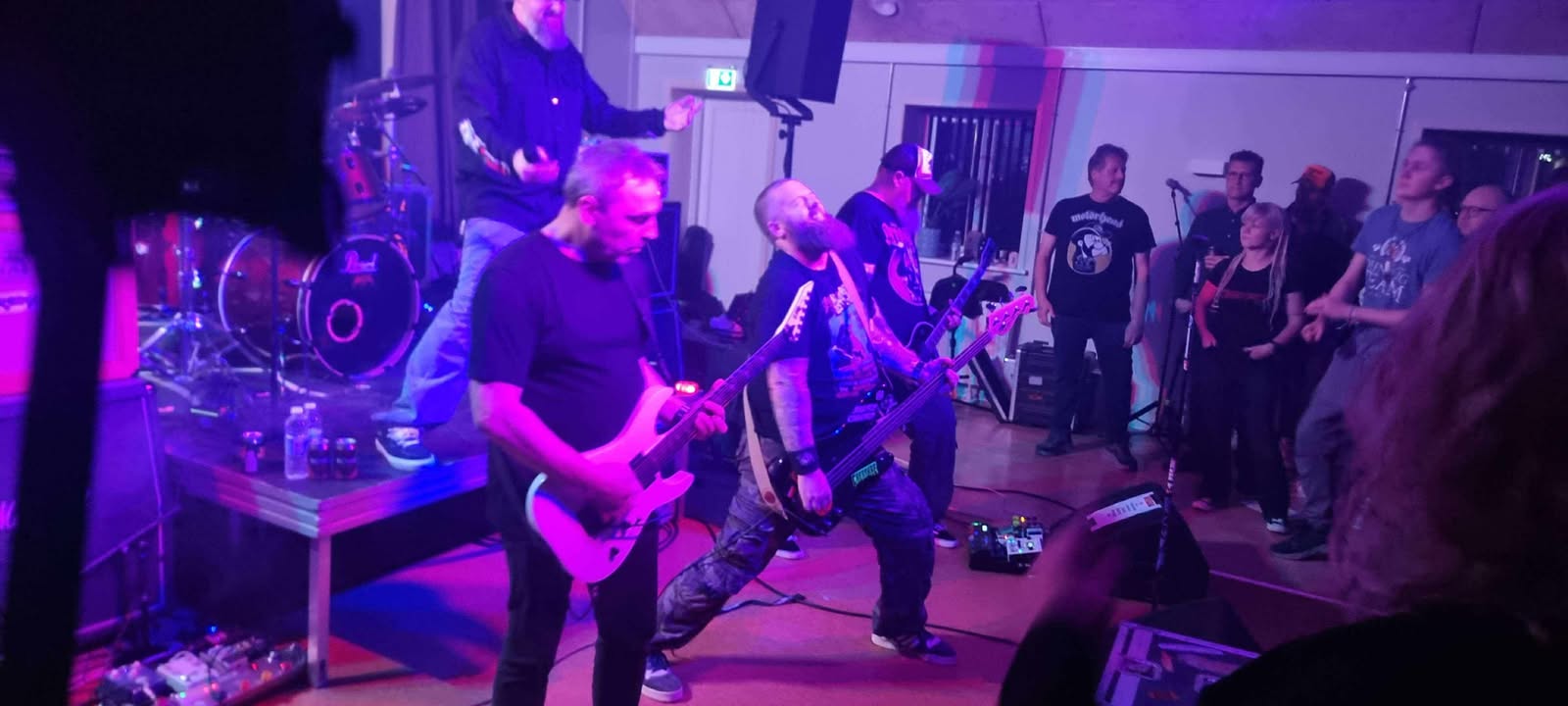
We’re planning some concerts and will try to get out as much as everyday life allows it, but generally speaking it looks like actual touring is becoming less and less viable even to established bands and the chance of just breaking even on a small tour seems less likely now, with more and more venues picking the pockets of the bands and their merch sales. I don’t think that’s a hassle we actually want to deal with. Takes the fun out of playing. I think we’ll do what we usually do – assess if a given job is worth it for us either financially or if it’s something we really want to do because of the other bands or the venue or whatever. It’s a difficult discussion. While we want to play, we don’t want to pay to play. That’s not how live music should work.
What does Fusskalt mean to you nowadays – a hobby, a lifestyle, or both?
-It’s definitely a bit of both. While we all love playing in Fusskalt, and want to dedicate as much time as possible to it, it does not pay the bills. So everything is a balance between work, families and of course actually getting some Fusskalt shit done. We’re by no means fast movers – but we DO move… usually forwards too.
Fun question
What’s something your fans definitely don’t know about you, but you think deserves a little spotlight? 😄
-Just like Superman is just a nervous reporter when he is not Superman – when we’re not rock stars, we’re just two school teachers, two 3D graphics designers, and one glorified gardener. How’s about that :D
