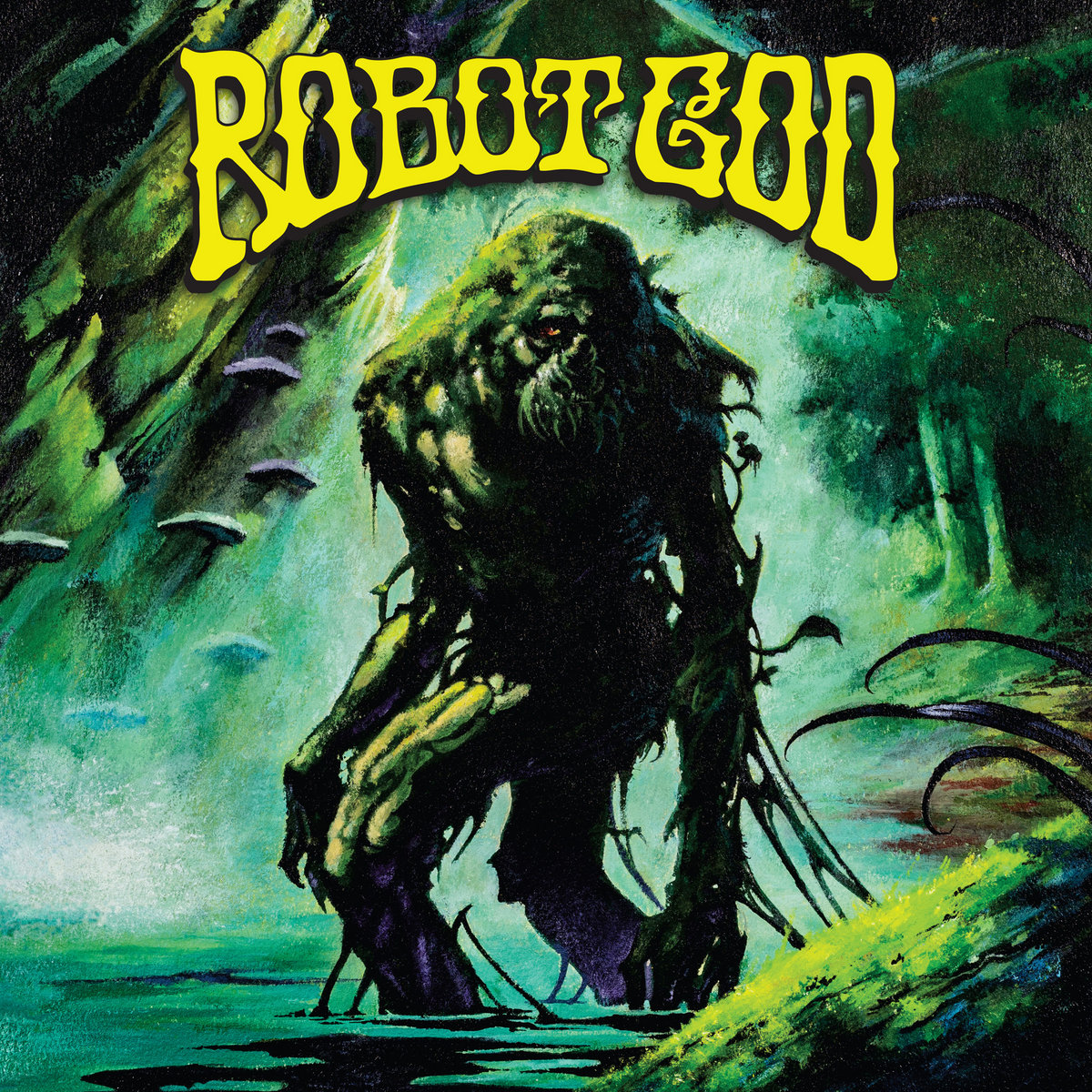
Australian heavy psych outfit Robot God haven't been resting on their laurels, with Curse of the Driven arriving surprisingly soon after Onto the Afterlife. This time around, the band seems to be taking a slightly more progressive turn, but thankfully, the sheer weight of their sound remains intact. Thick riffs and psychedelic excursions continue to define their sonic world, while the songs take on a more intricate shape. There's a noticeable emphasis on experimentation, instrumental exploration and longer musical passages.
None of this comes at the expense of the band's punch, though, as Robot God can still hit hard enough to get those neck muscles moving. Curse of the Driven is therefore more than just a continuation of the previous album; it's another step towards a broader, more progressive sound. What's particularly interesting is that, despite the relatively quick turnaround, the band isn't simply repeating itself but exploring new directions. Robot God are still travelling the path of heavy psychedelia, they're just taking a few more winding roads along the way.
We got to the festival pretty late on the third day. We got tired in the first two days... Partly because of partying, partly because of our age and partly because of the ca. 119-122 stairs that lead from the parking space to the festival. The exact number is not known due to the quantum uncertainty of the BearStone festival. We measured between these two extremes.
We prepared more or less deliberately for the acts on the main stage this evening. We saw the last act on the Jam stage, but the music was nothing to write home about and the sound guys were probably even more tired than us, as it sounded really bad. With this quite unpleasant feeling started the eclectic and colorful programme on the main stage.
Stone hard riffing. Hits hard. But does not engage. During the show I remembered that Spotify thorws two of their songs from time to time in my playlist, but no wonder I didn't really remember them. Still, many people love them and they delivered. They are professionals and very honest - qualities that are pretty rare today and need to be appreciated.
You shit in your pants. Unfortunately so did the electronics again. Maybe Godzilla turned in his dream, maybe the benevolent yeti stomped too hard, but the Multimeter Commando had again work to do. Our Mexican friends could finally start the show with 20 minutes delay, but even with a bit shortened set they could make the audience sing, trace the three-body problem and also deliver some technical proposals for its solution and last but not least bring world peace. Svejk honored their efforts with buying some merch and chatting with the band members.
For strategic reasons we went to the toilet at the beginning of this show. Elder is in the lineup of the Monolit Festival in Budapest, we already have our tickets, so we won't miss too much anyways. Buying some more alcoholic beverages took also some time, so we came back to the main stage only for the second half of the show. But what second half it was...! I left the guys behind and made my way all the way to the front (it wasn't easy, this show had the biggest crowd in the whole festival). I nodded, tilted and curved. I fell apart to my atoms and manifested in different forms. I sublimed, precipitated and crystalized. I saw all 26 dimensions of the Theory Of Everything, all at once. All this being sober, as I was the driver that day.
Short left, two gears back! We are on the night bus to Göreme, Turkey. There is some romantic action movie on the TV. We arrive to Nevsehir, one of Cappadocia's largest cities. The steward asks the passengers about their destinations (yes, Turkish long-range buses do have stewards, who distribute snacks, drinks, handkerchiefs and help passengers in general). Some loud American tourists just repeat "Cappadocia", like Brad Pitt in Inglourious Basterds when he tried to speak Italian. Yeah, twats? All 98 squarekilometers of it at once? But finally all is sorted, they get off, we arrive soon in Göreme as well. Ezme, pide, lentilsoup. The smell of markets. Cats and dogs everywhere and everybody is nice to them. Slowly sipped Turkish tea. Ok, it's not now, it's the past, but the music brought all these memories back.
We don't listen it too long though. We are tired, we want to go back to our place to have a drink or two and a cigarette. We spend our last euros from our cashless chips on some more beer. We say goodbye to the valley and the festival. Goodbye tired pizza-girl! Goodbye Mreznica! Goodbye toilets that smell like ammonium! Goodbye all 119-122 stairs! Goodbye BearStone! In the background the Altin Gün switches to more psychedelic tunes. We left again some parts of our souls here..
This year, on September 4–5, there will be a big Psych party in Pusztazámor! RoadkillSoda, who already proved themselves before Unida, will show here as well that they take their music seriously! To mark the occasion, we did a short interview with them.
- A large part of the Hungarian audience probably first encountered you as the opening act for the 2023 Budapest show of Unida. It was a memorable evening. Now you are returning to Hungary, this time to play at the Jam in the Psych Castle festival, which welcomes audiences with a unique location and a very strong international lineup. What does this festival mean to you, and what are you expecting from this special event.
- Hello everyone, Panda here from RoadkillSoda. Yeah, the whole tour with Unida was one hell of a good experience.Fun was had. We’ve played many times in Budapest thru the years, and each time was a blast. We’re expecting nothing but having a good time, and giving the audience a hell of a ride.
- RoadkillSoda’s music has always been defined by heavy grooves, powerful riffs, and raw rock’n’roll energy. At first listen, it might seem like a slightly different direction compared to some of the more psychedelic acts on the festival lineup. What do you think is the common ground that makes you a natural fit for this environment?
- Well genres are for critics. We play rocknroll. You can find find elements of stoner, grunge and psichedelic in our music. But I think RoadkillSoda is about pure rocknroll energy. And in a live set is the beat chance to experience that with us.
- You have been an active band for more than ten years. Looking back on this journey, what do you think has remained unchanged in RoadkillSoda since the beginning, and what are the areas where you have developed or changed the most?
- I’ve started this band back in 2011, and i’ve had the chance to play with a lot of good musicians. The drive and musicality remained the same. Music changed as I aged, and as I always like to say, you don’t wanna release the same song/album thru out your whole career, right?
- Since Sagrada (2020) – apart from Pandamonium Sessions Vol. 1 – we haven’t heard a new full-length album from you. Where does the new material currently stand? Is the atmosphere and direction of the next RoadkillSoda album already starting to take shape?
- Our I think 8th album is in the works. We have 3 songs completely done, probably 23 other songs in the works. I decided to take my time with this album, as the results are excelent for my taste and feel, and I don’t want to rush the process. But it will be a banger of an album.
- One of the interesting aspects of stoner rock is that many bands are constantly searching for a balance between traditional, heavy riffs and new musical ideas. When you write new songs, how important is it for you to preserve the familiar RoadkillSoda sound, and how much do you want to explore new territories?
- Well, songs always start from my guitar riff. So I think that is what makes it familiar. But, the one period in time when this happens is always different.So it’s always evolving. Also having changed members, brings it’s own twist to the song I bring. Everybody is different, but everybody keeps in mind the past of the band, and respects that, and I respect them for that.
- The Eastern European underground scene has been receiving increasing international attention in recent years. From the inside, how do you perceive this change? Is it easier today for a Romanian band to reach foreign audiences than it was when you started out?
- I think nothing really changed. There is not much interest for Romanian music. “Luck”? You make your own luck. You have to be consistent and visible. And play each show as if it’s your last. Make it count, as it might very well be.
- If you had to recommend a single RoadkillSoda song to someone discovering you for the first time, which one would best represent who you are today – and why would you choose that particular track?
- If it’s sho we are today, it would be the 2026 single, “Vita”. It’s a banger of a tune. Listen to it for yourself.
- If you had the chance to organize your own one-day festival with three other bands – whether they are active today or already considered legends – who would you invite to join you, and why?
- Well, we actually have our own festival here, RoadkillFest. But if it were any bands, active or not, Hendrix experience, Led zep and Black sabbath. Hell that’s where it all started, right?
- Over the past decade, the stoner, heavy psych, and doom scenes have changed a lot. More and more festivals, labels, and themed events are being built around this community, while streaming has completely transformed the way people listen to music. How do you see the current state of the stoner community? Has the audience changed? Are new, younger fans discovering the genre, or is it mostly the same generation keeping it alive? And perhaps most importantly: does that family-like underground feeling still exist – the feeling that made so many people fall in love with this scene in the first place?
- I think outside Romania, you do have a feeling of comunity. And whenever we tour, there is great fun to be had everywhere. Times change, our music remains the same. This is old music, played loud and proud. We release on tape and vinyl. Who wants that ‘70 feel will get it. Who doesn’t, won’t. It’s not for everyone, and that’s just fine.
- The stoner community has always been more than just a musical genre: for many people, it represents a mindset and a way of life. Do you still feel this sense of unity at concerts and festivals today? What do you think is something this community should never lose?
- Having a good time. Regardless of anything else. We are united by the music, for the music. This should have no limitations.
Day two started relatively early in the name of the mythical mutant prehistoric reptile: Godzilla. The monster left its mark on the whole day, let's see how it all happened...
Sara, Ale and Nico summoned Godzilla already with the first few chords. The barely 150cm tall monster arose from the river Mreznica, walked up to the stage and waited for the development of events. The band sprinkled tons of heavy riffs on the audience, soon a nice friendly moshpit manifested. In the center of it Alina (ca. 160cm, about 50kg with kettlebells) threw huge biker-alike guys to the left and right in her flip-flops. The fun peaked, beer flowed by the gallons. And that's what nourishes Godzilla too: every beer drunken in his vicinity makes him grow and get more drunken too. Only two songs remained, when the - then already grown huge - demon left the stage to discover the rest of the festival. He moved with the grace of a concrete gazelle built in brutalist style, so amps flew left, cabs flew right. The gig ended prematurely with Nico's drum solo.
The band was practicing in the outskirts of Graz, playing latin funk rythms, when sudenly the reverb pedal broke. They made their way to buy a new one. In the shop they were handed a suspicious orange device with the ancient runes "Distortion" on it. They put it in the effect chain and hearing the results Christian Kürschner started to scream. They all agreed it was splendid.
Matt Pike morphed into a beaver, jumped into the Mreznica and built a dam. The little river soon flooded the whole valley, turning it into a swamp. In the mysterious depths of the swamp ancient rythms roared, RoadkillSoda was summoning long forgotten alligator demons. In the rest of the night we turned our attention to the main stage. It's important to note here, that we appreciate the less informal and more direct ambience of the Jam and Mill stages. Of course it is a great experience to hear our favorites on the main stage: My Sleeping Karma, Uncle Acid, or 1000Mods, Gnome and Kadavar form the earlier years. These all sound great on such a big stage, but still, it is more like an entertainment service, than a shared experience with the band.
The show started really promising. It roared, screamed and delicately floated where it had to. For two songs, and then off it went. Literally. We still don't know to this day what has happened: maybe the unleashed Godzilla caused fatal tectonic movements? Maybe frying the curry chicken wrap that Svejk ordered has overloaded the electric line? Or maybe uncle Mirko in the neighbourhood got fed up with the noise and cut the power line? No-one knows... The Quick Responding Tectonic Assault Team of the Croatian Scientific Academy came to the site really fast and restored the power in about 40 Minutes. During this time the lead singer of Daevar entertained the crowd unplugged: - She started a whistle concert - She made the crowd sing - She started a silent circle pit - She body surfed - She made body surfing a guy who had his bachelor party at the festival - She made the crowd do a locomotive-dance for said guy So she did everything to contradict what I just wrote above about the main stage - and she did it right. At the end they had time for one last song, but they delivered undoubtedly one of the most extraordinary experiences of the festival.
The rest of the lineup on the main stage went as expected: Planet Of Zeus was a good craftman's work, but nothing more. Like you would take out the Van from 1000Mods, and would be left with Super Vacations only. My Sleeping Karmamade us a nice journey, at the end they summoned Ganesh, who hand in hand with the band's guitarist yeti hugged the runaway Godzilla, whispered "Gouranga, my brother" in his ears in a soothing voice. Godzilla fell asleep, finally everybody could relax. The main act of the night was Uncle Acid And The DeadbeatsThey reminded us Tarantino's Grindhouse, but our tired minds said: enough. So we made our way home, had a few more drinks a little chatter and off we went to the realm of dreams.
Big thanks to Mr. Schweyk for the photos and to DCS for the excellent report! AMEN!
Another sonic traveler joins the Psych Castle walls!
We are thrilled to announce that AcidSitter, one of Poland’s most exciting new psychedelic rock acts, will be joining the strange and wonderful world of Jam In The Psych Castle!
Fuzz-drenched guitars, hypnotic grooves, cosmic melodies and a healthy dose of psychedelic madness — AcidSitter are not just a band that plays songs, they open a gateway to another dimension.
Hailing from Kraków, the band blends the spirit of classic psychedelic rock with garage, stoner and krautrock influences, delivering a live experience full of energy, atmosphere and unexpected twists.
Get ready for another unforgettable encounter beneath the castle skies!
See you in Pusztazámor, where riffs, jams and psychedelic journeys take over the castle grounds!
Szavak és hangok a sivatag merengve lüktető torkából, dűnék felett cikázó akkordok, tétován gomolygó füst, vagy izzó száguldás. "Let the truth be known, Get stoned!"
(Ha zenét töltesz le a blogról, kérünk, hogy 24 órán belül töröld, és ha tetszik, vásárold meg legálisan, mert az úgy jó. Köszönjük.)


Kommentek